
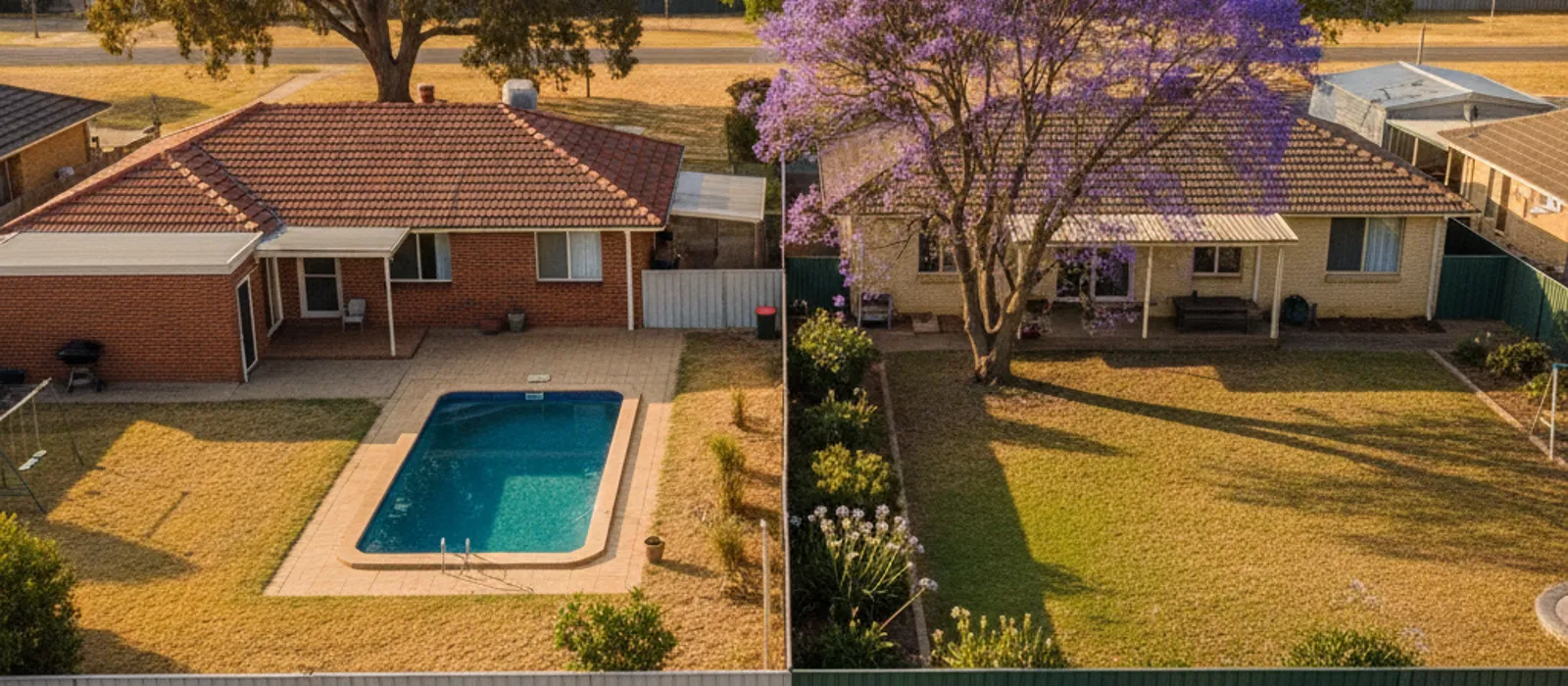
Two neighbours agree over the fence that one will hand over a two-metre strip of back yard. They shake on it, build a new fence on the new line and assume the deal is done. It isn’t. A new fence changes nothing on either certificate of title, and a boundary realignment in SA runs through the same plan, consent and deposit machinery as a subdivision.
The goal is different, though. A realignment shifts the line between blocks that already exist, so you finish with the same number of allotments you started with. This article explains what the process involves, which published fees to ask about, and where the unknowns are.
If you’re weighing one now, tell us what the survey is for and we will put you in touch with an independent Licensed Surveyor, who gives you a written quote and contracts with you directly.
What a boundary realignment in SA actually is
Land Services SA describes land division as “the alteration of the boundaries of land”, done under Part 19AB of the Real Property Act 1886 or under the Community Titles Act 1996. Moving a line between two existing blocks is an alteration of boundaries in exactly that sense. Common versions are swapping a strip between neighbours or straightening a dog-leg.
The number of allotments doesn’t change, but the shape and area of at least two of them do. That’s why it isn’t a fence job. The line on the title moves only when a plan is deposited and new titles issue.
Three jobs get confused here. Splitting one block creates a new allotment, moving a fence to match the title changes nothing on the title, and realigning changes the title but adds no block.
The law also decides who can do the survey side. The Surveyors Board SA says that in South Australia only licensed surveyors can undertake a boundary survey or place a survey mark that defines a property boundary. Under the Survey Act 1992 a plan must be certified by a surveyor who is a natural person (s 47). Land Services SA “strongly recommended” that owners get a professional licensed surveyor and a conveyancer or solicitor for a division.
Realignment, fence move or new block: which one are you facing?
This table matches the common situations to the route that applies.
| Situation | What changes on the titles | Usual route | Who decides |
|---|---|---|---|
| Neighbours agree to shift the line between two existing blocks | The boundary between two allotments; the allotment count stays the same | Land division plan (an alteration of boundaries), lodged with Land Services SA | Planning authority and the Commission, then Land Services SA |
| The fence is off the line but the title boundary is right | Nothing | Fences Act 1975 notices (Form 1, 2 or 3), or agreement between neighbours | The neighbours, then the Magistrates Court if they cannot agree |
| A building, driveway or eave crosses the boundary | Nothing until someone acts | Agreement, or a court application (the Encroachments Act 1944 s 4 lets either owner apply to the Land and Valuation Court) | A court |
| One block becomes two | One new allotment | Land division; one Adelaide firm, Sawley Lock O’Callaghan, says a standard one-into-two in the metro area is “in the order of $30,000 - $34,000” all up (page modified 12 May 2025, GST not stated) | Planning authority and the Commission, then Land Services SA |
Two points are worth pulling out of that table. First, a fence built off the line by agreement doesn’t give either owner title by adverse possession (Fences Act s 17). So an agreed fence isn’t a back door to a realignment. Second, a survey that shows the true line does not move it either. It tells you where the title says the boundary is, and then you decide what to do about it.
Our boundary surveys page explains what a survey of an existing line involves, and the Fences Act guide covers the notice steps when the only problem is a fence.
The steps for a boundary realignment in South Australia
Land Services SA sets out the general sequence for a land division, and a realignment follows the same path. The fact sheet predates the current Planning and Design Code, so treat this as an outline.
- Preliminary enquiry at council. Ask whether the new boundaries are allowed for the zone and any overlays in the Planning and Design Code. This article doesn’t publish minimum block sizes, because none are sourced here. The surveyor or council checks your zone.
- Engage a Licensed Surveyor and a conveyancer or solicitor. The surveyor prepares the plan. The conveyancer or solicitor prepares the application, a legal dealing lodged with Land Services SA.
- Planning consent, land division consent and agency advice. The Commission must report before a decision is made, and if no report arrives within 20 business days it may presume the Commission doesn’t want to make one. SA Water is identified in relation to all proposed divisions of land, and its assessment is valid for 60 business days.
- Certificate of Approval. The Commission issues a section 138 land division certificate once the prescribed conditions are satisfied.
- Lodgement. The surveyor lodges the plan through the Electronic Plan Lodgement system. The registered proprietors consent, and so does anyone with a registered interest on either title, such as a mortgagee.
- Examination, deposit and new titles. Land Services SA examines the plan and the dealings, deposits the plan and issues the titles.
For simple divisions assessed as deemed-to-satisfy, the General Regulations (r 22) let an accredited professional surveyor act as the relevant authority. That doesn’t apply where there are minor variations or where land must be vested in another entity or a public road created. Whether a given realignment qualifies is a question for the surveyor, not something to assume.
Most lenders want the plan deposited before settlements can occur, so tell yours early. On timing, the official wording is that a land division “can take many months, sometimes even years”. No official month figure exists for a realignment, so be wary of anyone who quotes one before seeing the title and the site.
What a boundary realignment costs in SA: the published fees and the gaps
Start with the gap. Adelaide survey firms don’t publish prices for boundary, feature and level, contour or set-out surveys, and none publishes a price for a realignment plan. Every firm page checked on 30 September 2026 says to ask for a quote. The surveyor quotes each job, and the price depends on the block, the evidence on site and the survey type.
For scale only, Trade Heroes, a national cost guide updated 6 March 2026, lists a boundary survey at $900 to $2,500 (GST not stated). That isn’t an Adelaide price, and a realignment plan is a different job.
What can be looked up are the government and plan fees. They change every 1 July, so these are the 2026-27 amounts from the Planning, Development and Infrastructure (Fees) Notice 2026 (Government Gazette, 12 June 2026) and the Land Services SA schedule:
- Land division authorisation (s 102(1)(c)/(d)): $210.00 for no more than 4 additional allotments and no public road.
- Commission advice (r 76): $240.00.
- Section 138 Certificate of Approval: $1,229.00.
- SA Water assessment: $480.00, credited against SA Water’s charges.
- Land Services SA surveyed plan: examination $1,231.00, deposit $189.00, $112.00 for each title, a Survey Act levy of $188.00, plus a document fee.
- Conveyancing Centre (SA): $660.00 including GST to prepare and lodge the division forms, plus $88 including GST for each consent arranged. That’s one firm’s published charge, not a market rate.
Don’t add those lines into a total. Which ones apply varies by application, and the surveyor’s and conveyancer’s fees sit on top. Treat the list as questions to put to them.
There’s one more figure to ask about. The 2026-27 open space contribution for Greater Adelaide is $10,166.00 per new allotment not exceeding 1 ha. A realignment creates no new allotment, but this article can’t tell you whether the planning authority raises open space for your job. Ask the council early and get the answer in writing.
To see how those fees stack up on a full two-lot split, read what it costs to subdivide land in Adelaide. If you want a written quote for your own realignment, send the form or call (08) 5550 3814, tell us what the survey is for, and we will put you in touch with an independent Licensed Surveyor.
Three anonymised blocks
These scenarios are built from the published rules above. They aren’t client stories, the dimensions are illustrative, and none predicts your cost or an approval.
A 1960s brick home on a 900 m2 block in Campbelltown. The owners want to buy a 3 m wide strip along the side from the neighbour so a driveway can pass the house. The result is two allotments before and two after, so it’s a realignment, not a split. The fee lines to ask about are plan examination ($1,231.00), deposit ($189.00), the Survey Act levy ($188.00), $112.00 for each title issued, the $1,229.00 section 138 certificate and the $480.00 SA Water assessment. If the neighbour has a mortgage, the lender is a registered interest whose consent is needed. The surveyor and council also check that both houses still sit properly inside the new boundaries under the Code.
A leaning Colorbond fence in Salisbury. Both neighbours believe the fence sits on their side, over a run of about 25 m. Nothing here is a realignment unless both owners want the title line itself changed. The first step is a survey of the existing boundary by a Licensed Surveyor, because an article like this one can’t tell you where your line is. Under the Fences Act the cost of “any survey that is reasonably required for the purposes of the fencing work” counts as a fencing cost. The Legal Services Commission says that if only one neighbour wants the survey, the person who arranges it pays. It also says a court is unlikely to order a fence moved when the deviation from the boundary is minor.
A Mount Barker buyer and a shed. The buyer’s contract is conditional on the seller realigning the boundary so that the shed sits wholly inside the lot being bought. Two issues follow. Most lenders want the plan deposited before settlement, and the official wording on timing is “many months, sometimes even years”, so the settlement date needs a conveyancer’s attention now. The Board recommends a Licensed Surveyor when buying, so you know about any encroachments. Pegs placed on an identification survey, though, “simply represent the surveyor’s opinion” of the boundary position, according to the Surveyor-General.
Five questions before you ring anyone
Work through these first, because most delays start with something nobody checked.
- Is the goal to change the title, or only the fence? If the title is right and the fence is wrong, you may not need a realignment at all.
- Is anything registered on either title? A mortgage or easement changes who must consent and what can sit within the strip.
- What sits in the strip? Water and sewer services, a shed or a tree all need answers before a plan is drawn, and SA Water is involved in every division.
- Do the buildings still fit inside both new boundaries? The surveyor or council checks this against the Planning and Design Code.
- Who pays, and what is the deal? If money changes hands between neighbours, a conveyancer or solicitor handles that side.
Leave the pegs alone while you work it out. By law you can’t move or remove a survey mark made by a licensed surveyor, and permanent survey marks carry fines of up to $2,000 each.
The Surveyors Board SA public information page explains how to check a surveyor’s licence, and the Land Services SA lodging plans page explains the lodgement side.
For the wider picture, our land division surveys page sets out what that work involves, and the guide to how to subdivide land in South Australia covers the split version of the same process. When you are ready, tell us what the survey is for and we will put you in touch with an independent Licensed Surveyor.
Frequently Asked Questions
Is a boundary realignment the same as subdividing?
Not quite. A subdivision creates a new allotment, while a realignment moves the line between allotments that already exist. Both count as an alteration of boundaries under Land Services SA’s definition of land division, so they share the same plan, consent and deposit steps.
Can we just move the fence and agree between ourselves?
You can agree where a fence goes, but that doesn’t change the title. A fence built off the line by agreement doesn’t give either owner title by adverse possession (Fences Act s 17). The boundary on the certificate changes only when a plan is deposited and new titles issue.
Who can do the survey, and how do I check their licence?
In South Australia only licensed surveyors can undertake a boundary survey or place a survey mark that defines a property boundary. Ask the Registrar (registrar@isasa.org.au or (08) 8212 0343) or check the Gazette list of Licensed and Registered Surveyors. We put you in touch with an independent Licensed Surveyor, who quotes and contracts with you directly.
How long will it take and what will it cost?
Land Services SA says a land division “can take many months, sometimes even years”, and no official month figure exists for a realignment. No Adelaide firm publishes a price for one either. A Licensed Surveyor quotes it after seeing the title and the blocks, and a conveyancer or solicitor quotes the legal side.