
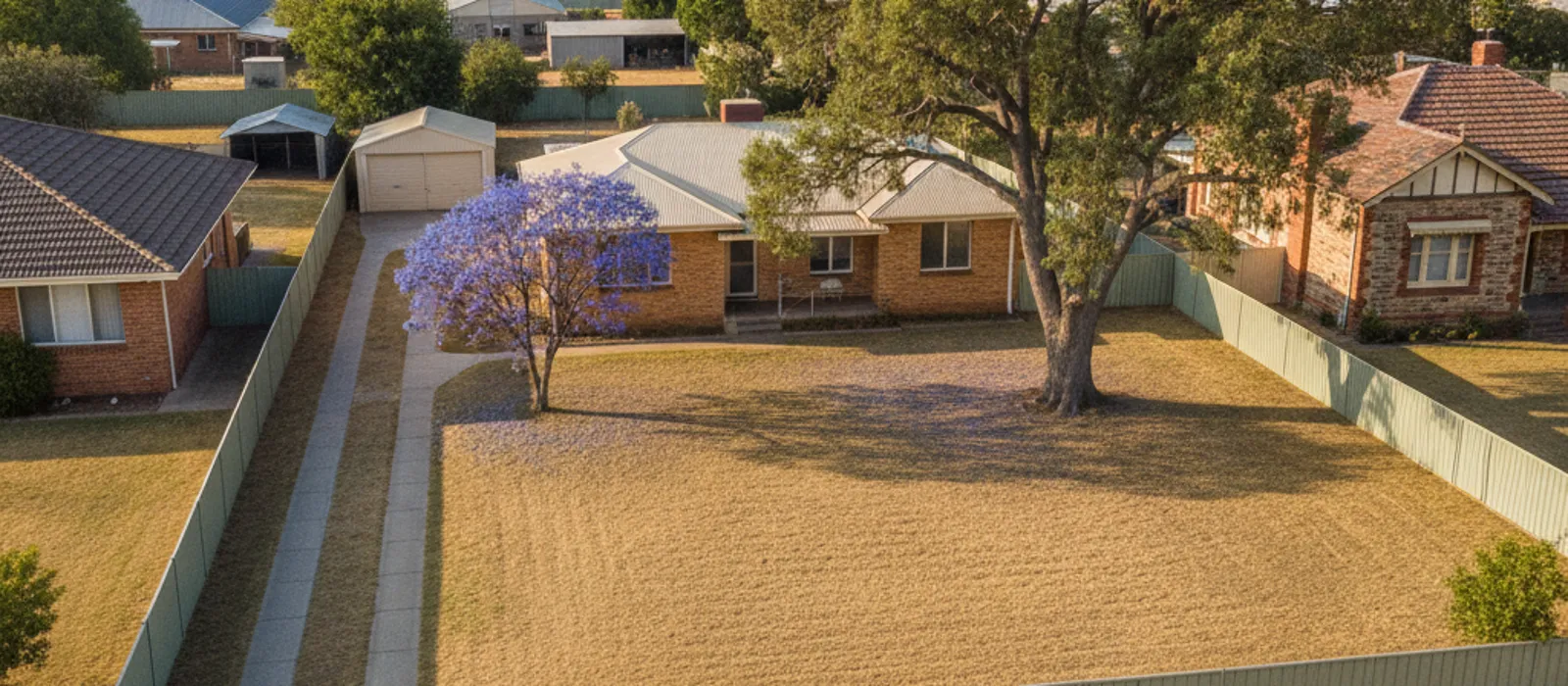
The most expensive mistake in a subdivision is paying for plans before you know the block can be split. So you search for the minimum block size for subdivision in Adelaide, find three different numbers on three different websites, and still can’t tell whether your backyard counts. This article explains why one number cannot answer the question, what does decide it, and how to find out cheaply before you commit.
We won’t print a minimum size here. The Planning and Design Code sets the rules by zone and overlay, and a figure copied from an advertiser’s page is the kind of thing that costs owners real money when it turns out to be wrong for their street.
If you already have a block in mind, tell us what the survey is for and we will put you in touch with an independent Licensed Surveyor, who quotes and contracts with you directly. The form comes first, and the phone is there if you’d rather talk.
Why there is no single minimum block size for subdivision in Adelaide
Ask ten people what size block you need to split in Adelaide and you will get ten answers, usually delivered with confidence. The reason is simple. The planning rules that apply to a land division depend on where the land sits. The zone your address falls in matters, and so do any overlays that sit on top of it.
Two blocks of identical area, a few streets apart, can be treated differently because of the zone or an overlay. Area is one input, not the whole test.
That is why the number you read online is at best a rule of thumb. Some firm pages give a figure as a guide. Treat it as a reason to ask, not as an answer, because we haven’t been able to confirm any such figure against the Code itself.
The Greater Adelaide Regional Plan 2025 shows why the question comes up so often. It says most new dwelling supply in western suburbs such as Findon, Plympton and Kurralta Park has come from small-scale infill. In the inner south, over 80 per cent of dwelling growth over the last five years has come from general infill. In Campbelltown, some infill has occurred, generally as townhouses. That doesn’t tell you whether yours can.
What actually decides whether your block can be split
Once you drop the idea of a single magic number, the real checks are more useful. Here’s who answers what.
| Question | Who answers it | What helps to have on hand |
|---|---|---|
| Do the zone and any overlays allow a division of this land? | The council, or a surveyor reading the Planning and Design Code against your address | Your address and certificate of title |
| Where would the new boundary go, and what is on site? | An independent Licensed Surveyor | Title, any existing plans, a note of sheds, fences and trees |
| Can water and sewer be provided to the new allotment? | SA Water assesses every division | The surveyor’s proposed plan |
| Are there easements, mortgages or other registered interests? | Your conveyancer or solicitor, with the title | Certificate of title, lender details |
| Which form of title will the new lots take? | Surveyor plus conveyancer or solicitor | Your plans for the land (see the title section below) |
A few things in that table need spelling out.
Zone and overlays. This is the question the minimum block size is really standing in for. The honest first step is a preliminary enquiry with the council, which is the first step in the Land Services SA list for a land division. A surveyor can also read the zone and overlays against your address.
Services. SA Water is involved in every division. Its assessment costs $480.00 in 2026-27, is valid for 60 business days, and the fee is credited against SA Water’s charges. The Regional Plan also notes limited housing-ready supply in parts of the outer north because of a lack of available connections for water and wastewater. Connection can be the deciding factor on a block that looks fine on paper.
Registered interests. If a mortgagee is on the title, it has to consent. Most lenders need the plan deposited before settlements. Raise this early with your lender, not in month eight.
Three blocks, three different questions
These are composites of the kinds of blocks owners bring to a surveyor. They aren’t real clients or real jobs, and the outcomes aren’t predictions.
A 1960s brick home on a 900 m2 block in Campbelltown. The owners want to split off the back garden and have been told that 900 m2 is “plenty”. It might be a good start, but area alone isn’t the test. The questions that matter are where the new boundary would fall relative to the existing house, where the driveway and services would run, and what the zone and overlays say for that street. A survey of what is on site helps answer the first two. The council and the surveyor answer the third.
The money looks like this. In Greater Adelaide the open space contribution is $10,166.00 per new allotment in 2026-27, and a two-lot Torrens division creates one new allotment. The Commission may require it for divisions of 20 allotments or fewer.
For the whole project, one Adelaide firm, Sawley Lock O’Callaghan, put a standard one-into-two division in the metropolitan area at “in the order of $30,000 - $34,000” on a page last modified 12 May 2025, GST not stated. That range covers state and council fees, Land Services SA plan fees, surveyor and consultancy fees, conveyancer or solicitor fees and SA Water fees. It is one firm’s estimate and it predates the 1 July 2026 fee changes.
A long block behind a 1970s house in Plympton. The owners want a rear allotment. The driveway runs down one side and the sewer connection sits somewhere they have never seen. Here the question isn’t area, it’s access and services. SA Water assesses every division, and the Adelaide firm above warns that it “may charge non-standard costs for water/sewer extensions, deeper connection pits, or dewatering costs”, which “could increase the costs significantly”. Power and NBN connection are extra.
A buyer looking at a big block in Mount Barker. The listing says “subdivide (STCA)”, and the buyer wants to know if the premium is worth paying. Mount Barker has averaged around 430 dwelling completions per year since 2017, mostly greenfield and township growth with “minor levels of infill”. That’s context, not a verdict on the block.
Before paying extra for potential, the buyer can ask for a written quote for the checks that matter: what the title says, whether the shed sits inside the boundary, and what the council says at preliminary enquiry. An identification survey before contracts are signed is one way to check that the house, shed and fences sit inside the title. The pegs represent the surveyor’s opinion of where the boundary is. Whether the block can be split is a separate question.
Torrens title or community title: pick before you count lots
Whatever size the block, you also have to choose the form of title. Land division in South Australia can be done under Part 19AB of the Real Property Act 1886 or the Community Titles Act 1996.
Torrens title gives you at least two allotments held independently of one another. There are generally no shared facilities. Community title gives you at least two lots and an area of common property, and by-laws are compulsory. Which one fits is a decision for you, your surveyor and your conveyancer or solicitor, not something a blog can make for you.
One thing you shouldn’t be offered: strata division. It’s no longer possible to create new strata divisions in South Australia. If a website or a salesperson describes strata as an option, treat that as a warning about their information.
For the full comparison, see Torrens title vs community title in South Australia. If a division is where you are heading, our land division surveys page explains what the surveyor’s part of the job covers.
The process after the size question is answered
Land Services SA sets out the steps. There is a preliminary enquiry at council, then you contact a land surveyor and a conveyancer or solicitor. After that come lodgement and approval through the State Commission Assessment Panel, lodgement with Land Services SA, examination of the plan, examination of dealings, deposit of the plan, and finally issue of title.
The surveyor lodges the plan through the Electronic Plan Lodgement system. A registered conveyancer or solicitor prepares the application. Land Services SA says it “strongly recommended” you get a professional licensed surveyor and a conveyancer or solicitor.
For simple divisions that meet the deemed-to-satisfy rules, an accredited professional surveyor may act as the relevant authority under General Regulations r 22. Whether your division qualifies is again something the surveyor and council confirm, not something to assume.
On timing, the only official wording is that a division “can take many months, sometimes even years”. There’s no official month count. Treat any advertised timeline as a marketing claim and ask what it is counted from.
The 2026-27 statutory fees have their own moving parts. Land division authorisation for no more than four additional allotments and no public road is $210.00. Commission advice is $240.00, and the Section 138 Certificate of Approval is $1,229.00.
Land Services SA charges for a surveyed plan from 1 July 2026 include $1,231.00 for examination, $189.00 for deposit, $112.00 for each title and a $188.00 Survey Act levy, plus a document fee. Which fees apply varies by application, so don’t add these up into a total. The full fee breakdown sets out where each one sits, and the step-by-step guide walks through the order of events.
How to find out cheaply if your block can be split
You can get a good read on your position before spending on survey plans. The order below keeps the early spend small.
- Get your certificate of title. It shows registered interests, easements and the land description. Everything else builds on it.
- Write down what is on site. Note the house, sheds, driveway, trees and fences. The surveyor will measure them, but a rough sketch shows you what to ask about.
- Ask the council for a preliminary enquiry. This is the first step in the official process. It’s where the zone and overlays are read against your address.
- Talk to a lender and a conveyancer or solicitor. A mortgagee must consent, and most lenders want the plan deposited before settlements.
- Then ask for a surveyor’s quote. Tell us what the survey is for and we will put you in touch with an independent Licensed Surveyor, who quotes and contracts with you directly.
Adelaide survey firms don’t publish prices for boundary or feature and level surveys. Every firm page we checked says to ask for a quote. Surveyors quote each job, and the price depends on the block, the evidence on site and the survey type. National cost guides exist. Trade Heroes, for example, lists a national range of $900 to $2,500 for a boundary survey (updated 6 March 2026, GST not stated), but that isn’t an Adelaide price. An Adelaide surveyor quotes your block.
Check the licence too. The Surveyors Board SA says that in South Australia only licensed surveyors can undertake a boundary survey or place a survey mark that defines a property boundary. There’s no searchable online register, but you can contact the Registrar at registrar@isasa.org.au or on (08) 8212 0343, or check the Gazette list of Licensed and Registered Surveyors, updated each July and January. Our boundary surveys page explains what that work involves.
Frequently Asked Questions
What is the minimum block size for subdivision in Adelaide?
There’s no single number we can give you. The rules depend on the zone and any overlays that apply to your address in the Planning and Design Code, so two blocks of the same area can be treated differently. Ask the council for a preliminary enquiry, and ask a Licensed Surveyor what they see for your street.
Can I subdivide a block if it is bigger than the minimum I found online?
Not on that basis alone. Figures on advertiser pages are unverified guides, and area is only one input. Services, access, the position of the existing house, easements and registered interests all count, so confirm with the council and a surveyor before paying for plans.
Can I create a strata title when I split my block?
No. It’s no longer possible to create new strata divisions in South Australia. The two options are Torrens title under the Real Property Act 1886 and community title under the Community Titles Act 1996, and your surveyor and conveyancer or solicitor can explain which fits your plans.
How much will a two-lot split cost?
One Adelaide firm, Sawley Lock O’Callaghan, put a standard one-into-two division in the metropolitan area at “in the order of $30,000 - $34,000” on a page last modified 12 May 2025, GST not stated. That includes state and council fees, plan fees, surveyor, conveyancer and SA Water fees, and SA Water may charge more for non-standard work. Your own cost depends on the block, so get a written quote.
This article is general information, not legal or planning advice. For the decision on your block, speak to a Licensed Surveyor, a conveyancer or solicitor, or your council. See the Land Services SA land division page and the Surveyors Board SA public information page for the official wording.