
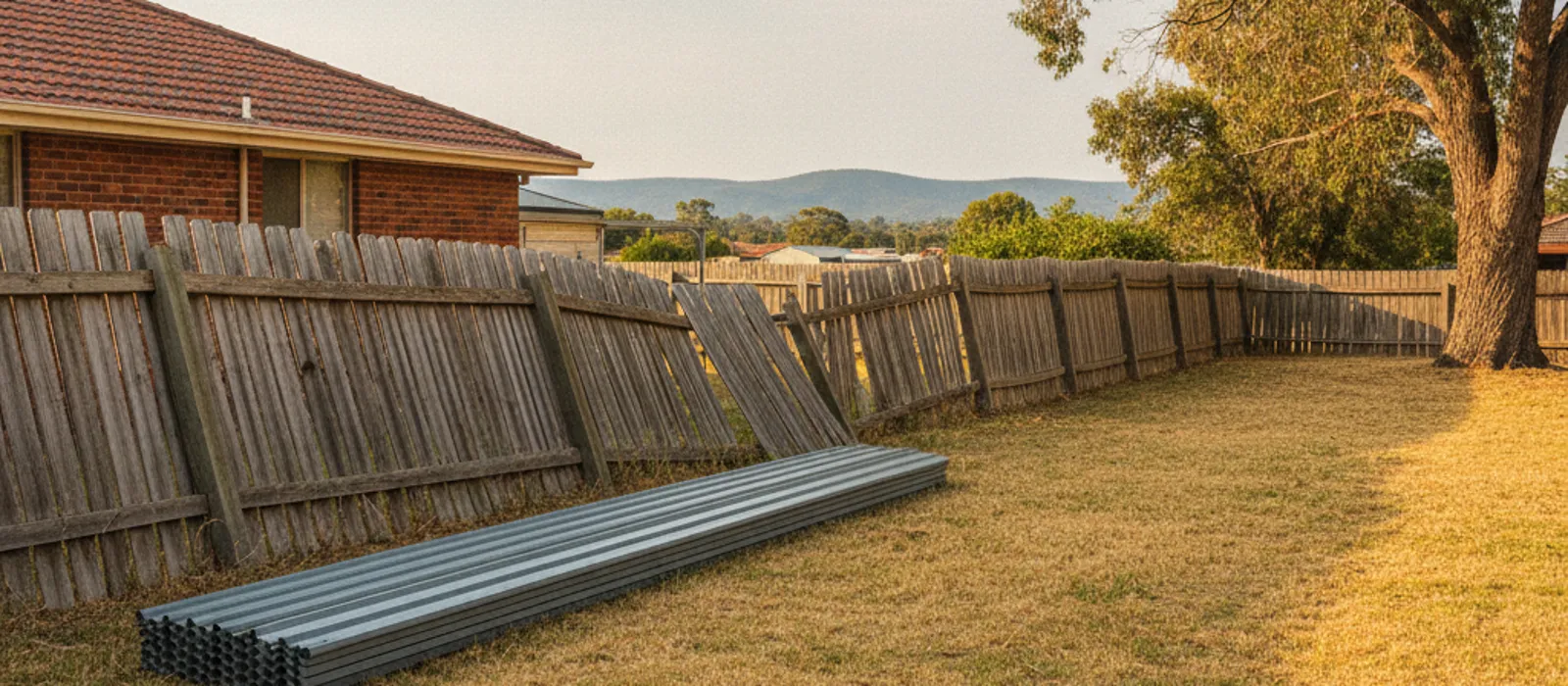
You have a quote for a new Colorbond fence, a neighbour who says the old one is on your side, and a 30-day clock that starts the moment a Fences Act notice is served. Before you sign anything, ask whether a boundary fence dispute survey should come first. Sometimes it should. Sometimes it’s money spent on a question nobody was really asking.
This article covers how fence disputes work in South Australia, what a survey can and cannot settle, and who pays. It’s general information, not legal advice.
Why a boundary fence dispute survey beats another argument over the fence
Most fence disagreements start with a belief, not a measurement. One owner thinks the old fence sits on the line. The other thinks it was always a bit over their side. Neither has looked at the title, and neither has pegs to point at.
Here’s the awkward part. A fence isn’t evidence of where the boundary is. SA Government guidance says the boundary can only be determined by a licensed surveyor, and that a fence’s existing location does not change the legal boundary, who legally owns the land, or who owns the fence. A fence that has stood for 40 years still only tells you where a fence stood.
The Surveyors Board SA says major discrepancies between boundaries and fencing aren’t uncommon and can be very difficult to rectify. If you’re arguing, you may both be wrong.
That’s the case for a survey. It replaces two opinions with a measurement made by someone the law recognises. In South Australia, only licensed surveyors can undertake a boundary survey or place a survey mark that defines a property boundary. Surveys by unlicensed practitioners have no legal standing.
What the Fences Act 1975 says before anyone hires anyone
The Fences Act 1975 (SA) sets the process, and it’s more useful than most owners expect. In short:
- A new fence starts with a Form 1 notice. It must state the length and position of the fence, its type, a cost estimate, the share you’re seeking, whether you’ll pay compensation if it encroaches, and who will build it.
- Repairs and replacements use Form 2. An objecting neighbour answers with a Form 3 cross-notice.
- The neighbour has 30 days to serve a cross-notice and doesn’t need to give a reason. If they say nothing in time, they are deemed to have agreed.
- Work can start after 30 days with no cross-notice, or after agreement or a court decision.
Nobody has to contribute to a fence unless both agreed, the proper notices were given, or a court orders it. Absent agreement, the neighbour’s share of an adequate fence is one-half of the minimum cost of erecting an adequate fence. Equal benefit is presumed unless someone proves otherwise.
Two points matter for disputes. First, the Act counts the cost of any survey that is reasonably required for the fencing work as a fencing cost. Second, if a neighbour objects and it goes to court, a Magistrate decides whether the survey was reasonably required. So a survey isn’t automatically shared, and it isn’t automatically refused either.
The Magistrates Court, which hears fencing matters as a minor civil action lodged online through CourtSA, can decide the line of fence to be adopted. It can also order removal of a fence not erected on the proper boundary. For the wider process, see our guide to the Fences Act and boundary fences in SA.
Two field scenarios: where a survey earns its fee and where it complicates things
These are anonymised, typical situations, not real jobs.
A leaning Colorbond fence in Salisbury
Picture a 1960s brick home in Salisbury. The Colorbond fence along the side has leaned for years, the posts are rusted at the base, and both owners are convinced it sits on their land. One owner wants it replaced. The other says it is already 20 centimetres over on their side and refuses to pay for a replacement in the same position.
Nothing in that story tells you who is right, and this article won’t guess. If the owner serves a Form 1 without settling the line, the neighbour can serve a cross-notice within 30 days and the matter heads toward a Magistrate who has no measurement to work from.
The cleaner path is to get a boundary survey done first. A Licensed Surveyor works from the title dimensions, locates the existing marks and the fence, and reports the offsets. If the fence is on the line, the argument ends. If it is over, the owners have a number to negotiate with, and the Legal Services Commission notes that a court is unlikely to order a fence relocated if the deviation from the boundary is minor.
Either way, the survey can be listed as a fencing cost on the Form 1. That’s the route the Act provides, with the risk that the neighbour objects to paying for it.
A bluestone villa in Unley with a wall on the boundary
Now take a bluestone villa in Unley. The side wall of the house sits on the title boundary, or close enough that the owner believes it does. The neighbour wants a new dividing fence, and the discussion is where the fence should meet the wall, whether the eaves and gutter overhang the neighbour’s side, and who owns the strip.
This is where a survey does more than settle a fence line. SA Government describes an encroachment as a structure that intrudes onto another person’s land, and it can include buildings, driveways, eaves and balconies. Encroachment disputes go to the Supreme Court, not the Magistrates Court, and the Encroachments Act 1944 lets either owner apply to the Land and Valuation Court.
A survey plan with offsets to the wall, eaves and fence gives everyone the same facts. The legal consequence is a question for a conveyancer or lawyer. If a fence dispute is really a building dispute, find out before you spend money on the wrong forum.
Who pays for the survey
This is the question owners ask second, right after “do we need one?” The Legal Services Commission’s booklet, Fences and the Law (December 2023), gives a straight answer, summarised in the table below.
| Situation | What the sources say | What it means for you |
|---|---|---|
| Both neighbours want the survey | They can agree to share the cost | Put the split in writing before anyone orders the work |
| One owner wants it, the other declines | Whoever commissions the survey pays for it | Budget for carrying it alone, unless a later notice or court order changes that |
| Survey listed on a Form 1 or Form 2 notice | Counts as a fencing cost if reasonably required; the neighbour may object | If it goes to court, a Magistrate decides whether it was reasonably required |
| The fence itself, once the line is settled | Absent agreement, one-half of the minimum cost of an adequate fence; equal benefit presumed | The survey answers where, not who pays for the fence |
| National price guide (not Adelaide) | Trade Heroes, updated 6 March 2026: boundary survey $900 to $2,500, GST not stated | An Adelaide surveyor quotes your block; don’t treat this as an Adelaide price |
On price, be careful. Adelaide surveying firms don’t publish prices for boundary surveys. Every firm page we checked says to ask for a quote. Surveyors quote each job, and the price depends on the block, the evidence on site and the survey type. The national range above is only a sense of scale, and interstate figures do not translate to an Adelaide block.
Before you accept a quote, run it past our land survey quote checklist. The wider picture is at land surveying costs in Adelaide.
What a fence dispute survey will and will not settle
A boundary survey by a Licensed Surveyor tells you where the legal boundary is in relation to your fence, your buildings and the marks on the ground. You get a plan and, where the surveyor places or reinstates marks, pegs you can see. That’s a firm footing for a conversation with a neighbour, a fencing contractor or a court.
It won’t:
- Decide who pays for the fence. The Fences Act does that, through notices, agreement or a Magistrate.
- Force a neighbour to move a fence. A fence built off the line by agreement stays where it is, and under section 17 neither owner acquires title through adverse possession of the land it encloses.
- Give you legal advice on encroachments. A survey shows the facts. A conveyancer or lawyer explains what follows from them.
- Tell you what the surveyor will find before they visit. Nobody can honestly say your fence is on or off the line without measuring.
One more distinction matters. Not every survey carries the same weight. The Surveyor-General notes that pegs placed on identification surveys simply represent the surveyor’s opinion of where the boundary is. If the dispute is heated, ask the surveyor which type of survey they are quoting and what the plan will show. Our pages on boundary surveys and identification surveys explain the difference.
Never move or remove a survey mark yourself. By law you can’t disturb a mark made by a licensed surveyor, and permanent survey marks carry fines of up to $2,000 each. Permanent marks aren’t boundary corner marks, so don’t treat one as a peg.
When a survey is the wrong first step
A survey is not always the first move. Three cases come up often.
The neighbour agrees on the line and disagrees on the fence. If you both accept where the boundary is and the argument is about type, height or share, you may not need a survey. The Act’s notice process and a chat over the back fence may be enough. Check council approval too: masonry fences over 1 metre, other fences over 2 metres, fences over 1 metre within 6 metres of a road intersection, and brush fences all need it.
The pegs are missing and the dispute hasn’t started. If you are simply about to build and can’t find the marks, a survey before the fence goes up is cheaper than an argument after. See what to do when survey pegs are missing for how that works.
You are buying, not fighting. Take a Mount Barker buyer looking at a house with a shed near the back fence. The Surveyors Board suggests engaging a Licensed Surveyor when buying or selling, so you know about any encroachments. That check is worth doing before settlement, when it can change a decision, not after, when it can only start a dispute.
Before you order anything, a short plan:
- Write down what you are disputing: the line, the fence, or the cost.
- Check the licence of any surveyor you are considering. There is no searchable online register, so contact the Registrar (registrar@isasa.org.au, (08) 8212 0343) or use the Gazette list of Licensed and Registered Surveyors, updated each July and January.
- Tell your neighbour before the surveyor visits. The Survey Act lets a surveyor enter land at a reasonable time for survey work, but a heads-up avoids a second argument.
- Decide who is paying, and put it in writing, before the work is ordered.
- Keep every letter, quote and photograph. A Magistrate will want to see them.
For authoritative background, read the Surveyors Board SA public information page at surveyorsboardsa.org.au and SA Government’s boundaries and fences guidance.
Torrens Survey Co is an advertising site. It doesn’t survey, peg or lodge anything. Tell us what the survey is for on the contact form and we put you in touch with an independent Licensed Surveyor, who quotes and contracts with you directly.
Frequently Asked Questions
Do I need a survey to put up a new fence in South Australia?
Not always. If you and your neighbour agree where the boundary is, you can go through the Form 1 notice process without one. If either of you disputes the line, a survey by a Licensed Surveyor is the way to establish it, and the Fences Act counts a reasonably required survey as a fencing cost.
Who pays for a boundary survey when neighbours disagree?
The Legal Services Commission says that if you both want the survey, you can agree to share the cost. If not, whoever commissions it pays. You can list it on a Fences Act notice, but your neighbour may object, and a Magistrate then decides if it was reasonably required.
Can a court make my neighbour move a fence that is over the boundary?
The Magistrates Court can decide the line of fence to be adopted and can order removal of a fence not erected on the proper boundary. The Legal Services Commission notes that a court is unlikely to order relocation if the deviation is minor. Speak to a lawyer about your own case.
How much does a boundary fence dispute survey cost in Adelaide?
Adelaide firms don’t publish prices for this work, so nobody can honestly give you an Adelaide figure without seeing your block. The national guide from Trade Heroes puts boundary surveys at $900 to $2,500, GST not stated, but that’s not an Adelaide price. A Licensed Surveyor quotes it after seeing the title and the site.