
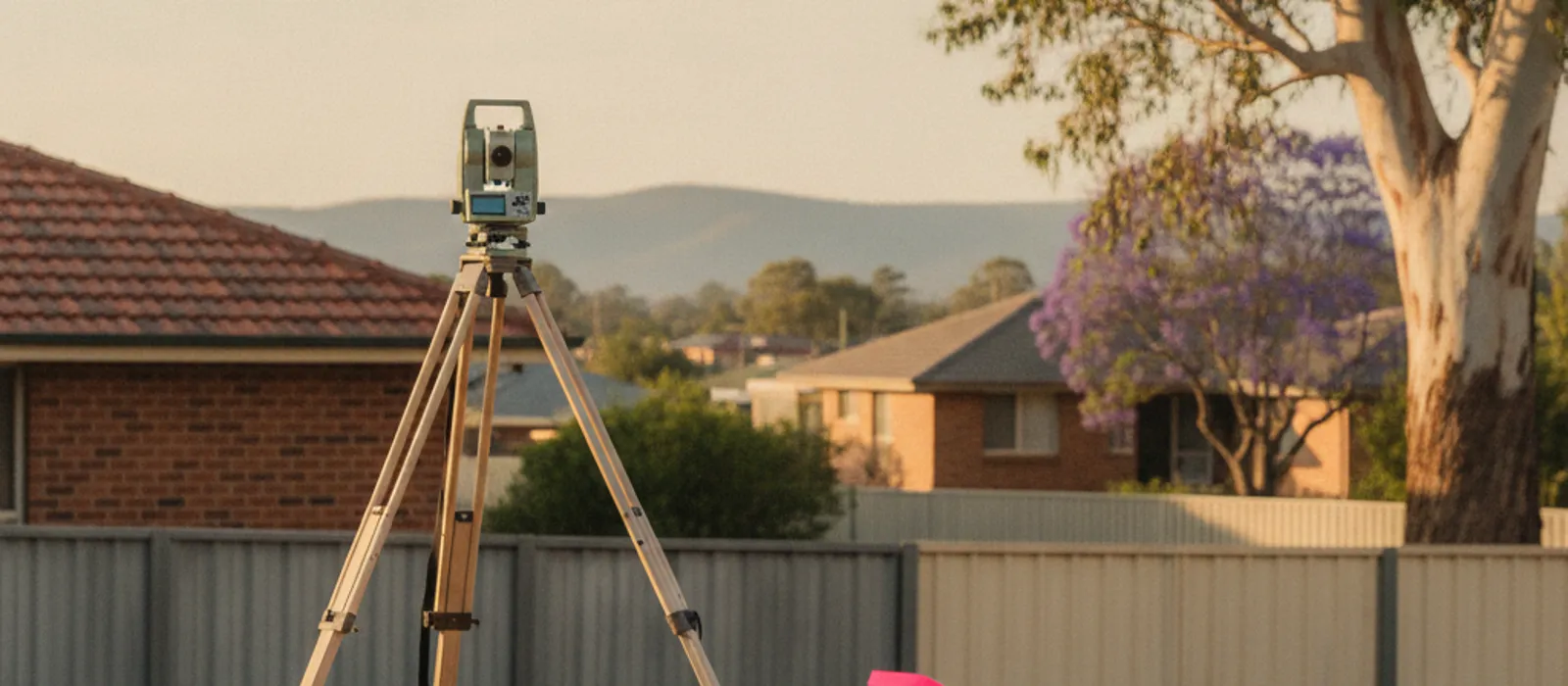
A fence, a shed and a set of building plans can all rest on one quiet assumption: that you know where your boundary is. A boundary survey is how you test that assumption, and in South Australia the law decides who is allowed to do it. Get it wrong and you can end up with a fence on the wrong line or a purchase that comes with someone else’s problem.
This guide is for Adelaide owners who are asking “do we need a survey?” and “what will it cost?”. It covers when a boundary survey earns its fee, who can legally carry one out, what the report should tell you and how to get a written quote before you commit. Torrens Survey Co is advertising, not a surveying firm. It holds no surveying licence and doesn’t survey. It puts you in touch with an independent Licensed Surveyor, who quotes and contracts with you directly.
If you already know what the survey is for, tell us what it is for and we’ll pass it to an independent Licensed Surveyor who can quote you in writing.
When a boundary survey earns its fee
Most owners reach for a boundary survey in one of five situations.
- A fence is going up or coming down and the neighbour disagrees about where the line is.
- A house, extension, garage or shed will sit close to a boundary.
- You’re buying or selling and want to know whether the buildings and fences sit inside the title.
- The pegs have gone and you need the boundary marked again.
- You’re thinking about splitting the block.
The Surveyors Board SA says major gaps between boundaries and fencing are not uncommon and can be very difficult to fix. That’s the argument for surveying before you build. A slab poured on the wrong line is a lot harder to move than a set of drawings.
The Board also advises engaging a Licensed Surveyor when you build on or near a boundary, and when you buy or sell, so you know about any encroachments. See its public information page.
One thing a boundary survey is not: a feature and level survey. If a designer or council wants the shape of your block, its slope and existing levels before plans go in, that’s a different job. A development application site plan has to show the boundaries and dimensions of the site, setbacks to boundaries and existing ground and floor levels where relevant. A feature and level survey is the usual way to get those levels and boundary offsets.
Who can carry out a boundary survey in South Australia
Only a Licensed Surveyor can. The Surveyors Board SA puts it plainly: in South Australia, only licensed surveyors can undertake a boundary survey or place a survey mark that defines a property boundary. Every property boundary survey has to be conducted or supervised by a practising Licensed Surveyor, and surveys by unlicensed practitioners have no legal standing.
The Survey Act 1992 backs that up: only a licensed surveyor, or someone under supervision, may place a survey mark (s 14), and a cadastral survey done for a fee has to be done by or through one (s 15). Measurements from anyone else can be handy for planning, but they’re not a boundary survey.
There are two licence types. Licensed Surveyors have expertise in identifying and measuring property boundaries. Registered Surveyors work in other areas, such as engineering, mining and hydrographic survey. For a boundary job, you want the first kind.
Checking a licence. South Australia has no searchable online register. You can ask the Registrar (registrar@isasa.org.au, (08) 8212 0343) or check the Gazette list of Licensed and Registered Surveyors, which is updated each July and January. The Board can investigate and prosecute unauthorised people who carry out property boundary surveys.
Survey marks. By law, you can’t move or remove a survey mark placed by a licensed surveyor. Permanent survey marks are a separate matter: they must not be disturbed without the Surveyor-General’s approval, fines run up to $2,000 per mark, and they don’t mark the boundary corner.
What a boundary survey report should show
The scope is whatever the quote says, so ask for it in writing. In general, a Licensed Surveyor compares the title and plan with the evidence on the ground, such as existing marks, fences and structures, measures the site and reports where the boundary sits in relation to what is built. Marks may be placed if that’s part of the job.
Here’s where names get muddy. An identification survey is one common type, often used when buying. The Surveyor-General notes that pegs placed on an identification survey simply represent the surveyor’s opinion as to the position of the boundary, and that these surveys are recorded publicly by lodging a Plan for Information Purposes. That doesn’t make them worthless, but you should know which type you are paying for. See our guide to an identification survey before buying.
Before you accept a quote, ask:
- Does the scope match what the survey is for?
- Will marks be placed, and will a plan be lodged or recorded?
- What will I receive, and in what form?
- Is the price including or excluding GST?
- What would change the price, such as old fences or missing marks?
Site conditions move the work. A cleared block with clear evidence is a different job from one where old fences have wandered and nobody agrees on the history.
A survey also tells you where the line is. It doesn’t move a fence or force a neighbour to agree. Fencing disputes go to the Magistrates Court, which can decide the line of fence to be adopted. Encroachment disputes go to the Supreme Court, and the Encroachments Act 1944 (s 4) lets either owner apply to the Land and Valuation Court. The Legal Services Commission notes a court is unlikely to order a fence moved if the deviation is minor.
The state government’s boundaries and fences page has the overview, and our boundary surveys page explains the service.
Three Adelaide situations, and what the survey did for each
These are composites, not case studies. Details are changed and no real person or job is described.
A leaning Colorbond fence in Salisbury
Both neighbours are sure the fence sits on their side. One wants it replaced and the other says it’s fine.
Under the Fences Act 1975 (SA) (see our fences and boundary guide), the person wanting new fencing serves a Form 1 notice with the length, position, type, cost estimate, the share sought and the contractor. The neighbour has 30 days to serve a cross-notice, and needs no reason. If nobody objects in time, that counts as agreement.
The survey cost has its own rule. The Act treats the cost of any survey reasonably required for the fencing work as a fencing cost. The Legal Services Commission adds a practical point: if you both want the survey you can agree to share it, but if not, the person who arranges it pays. Without agreement, the neighbour’s share of an adequate fence is one-half of the minimum cost of erecting one.
A survey gives both households a measured line to work from. Council approval is a separate check: it applies to masonry fences over 1 m and other fences over 2 m, among other cases.
A shed and a buyer in Mount Barker
A buyer is under contract on a house with a large rear shed. The shed looks close to the back fence, and the fence looks a bit off. The title does not show where the shed sits.
The state government’s definition of an encroachment covers exactly this: a structure that crosses the legal boundary onto another person’s land, including buildings, driveways, eaves and balconies. Whether this shed is one, nobody can say without measuring against the boundary.
This is where the survey type matters. The buyer should ask the surveyor whether the report shows the shed and fence relative to the title boundary, whether marks are placed, and whether the work can be done within the contract dates. Don’t assume it can. Easements on the title are for the conveyancer to read.
If the result isn’t clean, the buyer has a decision to make before settlement, with advice from a conveyancer or lawyer. That’s a far better time to find out than after.
A 1960s brick home on a 900 m2 block in Campbelltown
The owners are wondering about splitting the block and have heard figures from “not much” to “a fortune”.
The Greater Adelaide Regional Plan 2025 notes some infill in Campbelltown City Council, generally as townhouses. That doesn’t tell you your block qualifies. Whether a block can be divided at all is a planning question for the council and the Planning and Design Code, covering zone and overlays. It’s not something a survey answers.
On cost, the honest picture is a whole-project number, not a survey number. An Adelaide surveying firm, Sawley Lock O’Callaghan, says a standard one-into-two division in metropolitan Adelaide costs in the order of $30,000 to $34,000, including state and council fees, Land Services SA plan fees, surveyor and conveyancer fees and SA Water fees (page modified 12 May 2025, GST not stated). It warns that non-standard SA Water costs for water and sewer extensions, deeper connection pits or dewatering could increase the costs significantly, and that power and NBN connection are extra.
One of the government fees is the open space contribution. For 2026-27 it is $10,166.00 per new allotment in Greater Adelaide, and a two-lot division creates one new allotment. The Planning Commission may require it for divisions of 20 allotments or fewer. Other fees apply too, depending on the application.
Land Services SA (LSSA) says the division of land can take many months, sometimes even years. It also strongly recommends a professional licensed surveyor and a conveyancer or solicitor. The survey is one early piece of a long process. See our guide to the cost to subdivide land in Adelaide for the steps in order.
What a boundary survey costs in Adelaide
Here’s the awkward part: nobody publishes an Adelaide price. When we checked on 30 September 2026, none of the South Australian surveying firms we looked at published a price for a boundary survey. Every page said to ask for a quote.
Surveyors quote each job. The price depends on the block, the evidence on site and the survey type. Anything below is a guide to scale, not a quote.
| Figure | Source and date | What it covers | Is it an Adelaide price? |
|---|---|---|---|
| $900 to $2,500 | Trade Heroes national cost guide, updated 6 Mar 2026 (GST not stated) | Boundary survey, national range | No, national |
| AUD $800 to $2,500 | EastWest Surveyors national guide, 16 Nov 2025 (GST not stated) | Boundary or identification survey, national range | No, national |
| $30,000 to $34,000 | Sawley Lock O’Callaghan, Adelaide firm, page modified 12 May 2025 (GST not stated) | Whole one-into-two land division, all fees included, power and NBN extra | Adelaide, but for the whole project |
| $10,166.00 per new allotment | Planning fees notice, in effect 1 July 2026 | Open space contribution, Greater Adelaide, 2026-27 | Statutory fee, may be required |
The two national guides differ at the bottom, which shows how loose a national range is. Treat them as a sanity check, because an Adelaide surveyor quotes your block.
Government fees change every 1 July, so any fee should carry a financial year. Don’t add fee lines into a “government total”, because which fees apply varies by application.
Getting a quote you can compare
Good quotes start with a good description. Give the address, what the survey is for, what is built near the boundary, any fence notice or dispute under way, and your deadline. Ask for the scope, deliverables and price in writing, with GST stated. If the first quote is well off what you expected, get a second.
Before you sign anything, confirm the surveyor’s licence with the Registrar or the Gazette list. Torrens Survey Co doesn’t survey, so the contract is between you and the Licensed Surveyor, not with us.
To start, tell us what the survey is for using the contact form. We pass the request to an independent Licensed Surveyor who quotes you directly. If you’d rather talk it through, call (08) 5550 3814.
Frequently Asked Questions
Can I use my fence or my own measurements as the boundary?
No. A fence is where somebody built it, not necessarily where the title says the line is. The Surveyors Board SA says major discrepancies between boundaries and fencing are not uncommon. Only a boundary survey by a Licensed Surveyor has legal standing.
How much does a boundary survey cost in Adelaide?
Surveyors don’t publish Adelaide prices, so anyone quoting a fixed figure without seeing the title and the block is guessing. National guides give ranges such as $900 to $2,500, but those aren’t Adelaide prices. Tell us what the survey is for to get a written quote from an independent Licensed Surveyor.
Who pays for the survey in a fence dispute?
If you both want the survey, you can agree to share the cost. If not, the Legal Services Commission says the person who arranges the survey pays for it. Under the Fences Act, the cost of a survey reasonably required for the fencing work counts as a fencing cost, so keep the paperwork and get legal advice if you’re unsure.
Do I need a boundary survey to subdivide?
Land division is the alteration of boundaries under the Real Property Act 1886 or the Community Titles Act 1996. Land Services SA strongly recommends a professional licensed surveyor and a conveyancer or solicitor, and the surveyor lodges the plan electronically. Whether your block can be divided is a question for the council and the Planning and Design Code.