
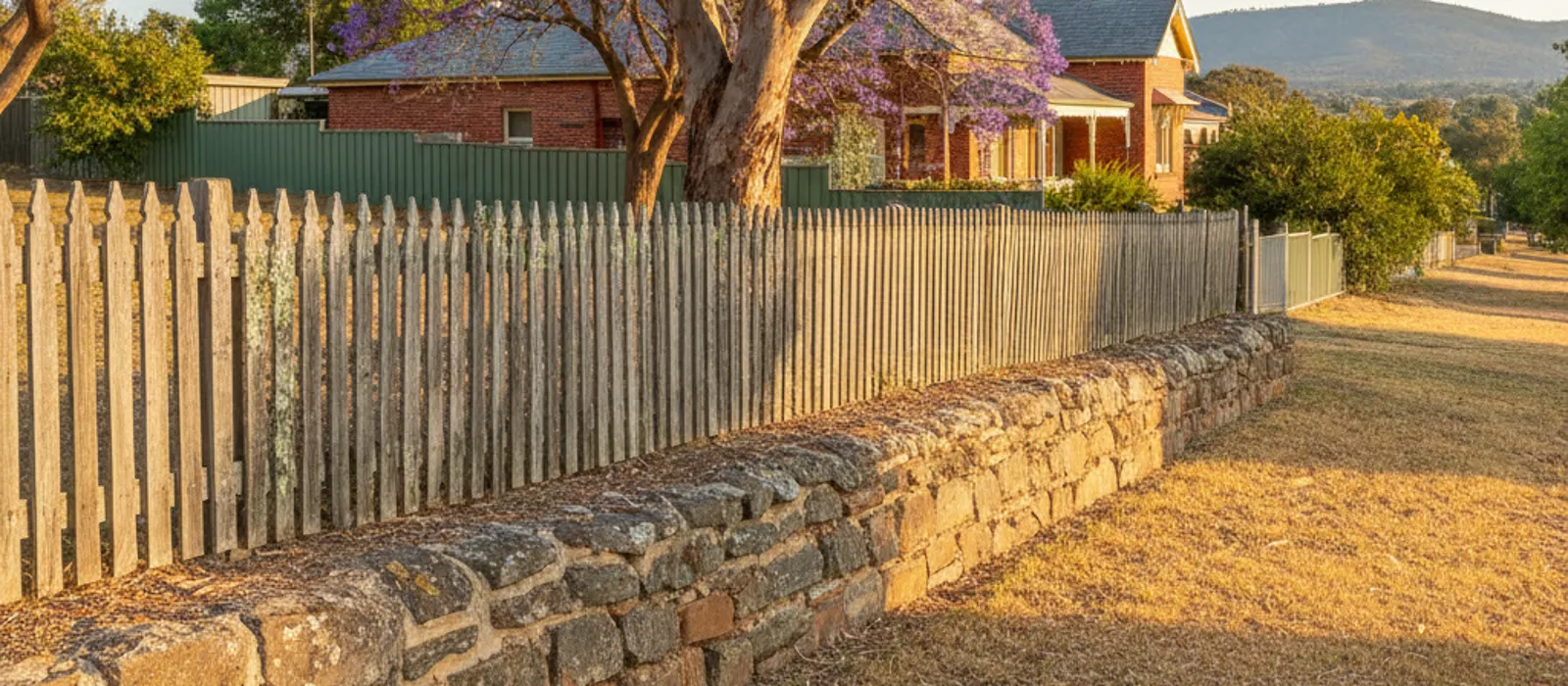
A retaining wall holds up a bank, and it also makes the boundary look like it’s somewhere it may not be. Nearly every argument about a retaining wall on boundary SA properties starts with the same assumption: the wall must be on the line, or on “our side” of it.
That assumption is often wrong, and it’s expensive to find out after the concrete is poured. This guide covers how ownership of a boundary wall is usually worked out, what a survey can and cannot tell you, and how costs and approvals fit around it. It’s general information, not legal advice.
If a wall is already in the way of a fence, a purchase or a set of plans, you can tell us what the survey is for and get a written quote from an independent Licensed Surveyor. We put you in touch with the surveyor, who quotes and contracts with you directly.
Who owns a retaining wall on the boundary in SA
There’s no rule that says “the higher side owns it” or “whoever built it owns it”. What matters is where the wall stands compared with the legal boundary on the certificate of title. That’s a measurement, not an opinion.
As a general principle, a structure wholly on your title is yours to look after, and one wholly on your neighbour’s title is theirs. A wall that straddles or crosses the line is where trouble starts. The SA Government describes an encroachment as a structure that “intrudes onto another person’s land, crossing the legal boundary”, and says that can include buildings, driveways, eaves and balconies. A retaining wall can do the same thing.
So the honest answer to “who owns it?” is “it depends where it sits”. Nobody can say where it sits until the boundary has been identified on the ground.
| Where the wall sits | What it usually means | Sensible first step |
|---|---|---|
| Wholly on your land | Your structure, your upkeep, your risk if it fails | Confirm it with a survey before spending more |
| Wholly on the neighbour’s land | You may be relying on something you don’t own | Identify the boundary, then write to the neighbour |
| Straddling the line | Both owners have an interest | Fix the position, then take advice from a conveyancer or lawyer |
| Position unknown | Any plan, fence or contract that relies on it is a guess | Ask an independent Licensed Surveyor to quote |
Why the wall and the boundary are rarely the same line
Walls get built for drainage, access or a flat patch of lawn. On older properties the builder often worked from the existing fence, not the title.
The fence is often wrong too. The Surveyors Board SA says “major discrepancies between boundaries and fencing are not uncommon and can sometimes be very difficult to rectify.” A wall built to follow a fence inherits the error and makes it permanent.
Retaining walls also sit in cuts and fills, so the ground either side has usually been altered. Original pegs may have been dug out or buried. Without them, the boundary has to be re-established from other evidence, and that’s a job for a Licensed Surveyor, not a tape measure.
The Board states: “In South Australia, only licensed surveyors can undertake a boundary survey or place a survey mark that defines a property boundary.” A sketch from a builder or a neighbour has no legal standing.
You can check any surveyor’s licence. There’s no searchable online register, so contact the Registrar at registrar@isasa.org.au or on (08) 8212 0343, or use the Gazette list of Licensed and Registered Surveyors, updated each July and January. The Board explains the categories on its public information page.
Three situations where a boundary wall becomes a survey job
These are illustrations, not real jobs, and every dollar figure is labelled with its source.
The block split in Campbelltown
Picture a 1960s brick home on a 900 m2 block in Campbelltown. The owners want to split it. At the back, a stepped masonry wall holds up the garden, and the new lot would be drawn right beside it.
The wall is now a feature the plan must deal with, a structure someone will own after the split, and possibly part of the line the new boundary follows. Division plans generally show relevant topographic features and any buildings to be kept, so the surveyor will want the wall located precisely.
Know the money before you fall for the idea. Sawley Lock O’Callaghan, an Adelaide surveying firm, says a standard one-into-two division in metropolitan Adelaide costs “in the order of $30,000 - $34,000”, including government, plan, surveyor, conveyancer and SA Water fees (page modified 12 May 2025, GST not stated). It warns SA Water’s non-standard costs “could increase the costs significantly.” One government item is the open space contribution: $10,166.00 per new allotment in Greater Adelaide for 2026-27, and a two-lot Torrens division creates one new allotment.
A wall over the proposed line doesn’t end the project, but the design, the surveyor and a conveyancer need to talk before anything is lodged. Whether a division is allowed is for the council and the planning system. Land Services SA says division “can take many months, sometimes even years.” See our land division surveys page.
The sloping block in Stirling
Now picture a sloping Stirling block where a designer wants to draw a new home. A timber sleeper wall runs along one side, and the designer needs existing levels first.
Schedule 8 of the Planning, Development and Infrastructure (General) Regulations 2017 asks for a site plan showing the site boundaries, the distance from proposed buildings to each boundary, and existing and proposed levels, “showing the height and location of any earthworks or retaining walls (if relevant)”. The regulation doesn’t say who prepares it. A feature and level survey is the usual way to get the existing levels and boundary offsets.
That’s where the wall shows up: its position, its top and bottom levels and its offset from the boundary. Read more about feature and level surveys.
Trade Heroes, a national cost guide updated 6 March 2026 (GST not stated), puts a feature and level survey at “$800 to $2,200”. That’s a national range, not an Adelaide price. An Adelaide surveyor quotes your block.
One caution. How a wall is built, how high it can safely go and what load it carries from a driveway or building above are engineering questions. A surveyor measures. A structural or geotechnical engineer designs and checks. If the wall is tall, holds back a lot of soil or has a building above it, ask the council whether an engineer’s design is needed.
The buyer in Salisbury
Last, picture someone buying a 1970s home in Salisbury. The back garden is terraced, and a masonry wall along the rear looks like it leans towards the neighbour. The agent says the fences have “always been fine”.
The Surveyors Board SA recommends a Licensed Surveyor when buying or selling, so you are “aware of any encroachments”. An identification survey shows whether the house, shed, fences and walls sit inside the title. The Surveyor-General notes that identification pegs “simply represent the surveyor’s opinion as to the position of the boundary”, and the survey is publicly recorded by lodging a Plan for Information Purposes.
If a wall does cross the line, you learn it while you can still choose. Ask a conveyancer or lawyer how to handle it in the contract. More in identification surveys before buying.
Retaining wall boundary disputes and what the law says
Most disputes come down to three questions. Is the wall on the line? Whose is it? Who pays to fix it? A survey settles the first. The law and a professional adviser take it from there.
The Fences Act 1975 (SA) deals with dividing fences. Whether your retaining wall counts as one, or forms part of one, is a legal question. Don’t assume the answer; the Legal Services Commission or a lawyer can tell you. Where the Act applies, the cost of “any survey that is reasonably required for the purposes of the fencing work” counts as a fencing cost. Our Fences Act guide covers the notices and the 30-day window.
If the Fences Act isn’t the right tool, encroachment rules are. The SA Government says encroachment disputes go to the Supreme Court and fencing disputes to the Magistrates Court. Section 4 of the Encroachments Act 1944 lets either owner apply to the Land and Valuation Court for relief. Which route suits you is a lawyer’s call.
The Legal Services Commission says that in a dispute about where a fence should go, “get a survey done which will show the precise location of the boundary.” If you both want it you can share the cost. If not, the person who arranges the survey pays.
The Board’s warning applies: “A boundary dispute can result in expensive litigation, particularly if major improvements you are undertaking need to be removed or relocated.” A retaining wall is a major improvement by any measure. If you’re there, tell us what the survey is for and we will put you in touch with an independent Licensed Surveyor.
Building or replacing a retaining wall near the boundary
Three checks save most of the pain.
First, find the boundary. The Board says that when building on or near a boundary you should engage a Licensed Surveyor. Once a wall is built over the line, the fix can mean demolition.
Second, ask the council and PlanSA whether the work needs approval. Don’t borrow fence thresholds. The SA Government lists council approval for masonry fences over 1 metre and other fences over 2 metres, but a retaining wall is assessed for what it is.
Third, talk to the neighbour in writing before anything is dug. Excavating beside a boundary can affect their soil, fence and footings.
A survey won’t design the wall or predict what the council will say. A wall that needs a qualified engineer on site, or an outage window because services run through the area, is a separate conversation.
If pegs or survey marks are in the way, leave them alone. The SA Government states that “by law, you cannot move or remove a survey mark made by a licenced surveyor.” Permanent survey marks must not be disturbed without the Surveyor-General’s approval, with fines of up to $2,000 per mark. See what to do when survey pegs are missing.
What a survey for a boundary retaining wall costs
Adelaide survey firms don’t publish prices for boundary, feature and level or contour surveys. Every firm page checked on 30 September 2026 says to ask for a quote. The price depends on the block, the evidence on site and the survey type.
For scale, the only figures are national. Trade Heroes (updated 6 March 2026, GST not stated) gives these ranges. They aren’t Adelaide prices.
| Survey type | What it tells you about a wall | Trade Heroes national range |
|---|---|---|
| Boundary survey | Where the title line is, and how far the wall sits from it | $900 to $2,500 |
| Feature and level survey | The wall’s position and levels, and offsets to the boundary | $800 to $2,200 |
| Contour survey | Ground levels either side of the wall | $1,200 to $3,000 |
| Identification survey | Whether structures sit inside the title, for a buyer | No separate figure; the surveyor quotes it |
An Adelaide surveyor quotes your block. A steep site, a long wall or missing pegs will each push a quote differently.
When you ask for quotes, say what the survey is for. “Is this wall over the line before I fence?” is a different job from “my designer needs levels”. Our land survey quote checklist helps you compare what each quote includes.
To start, tell us what the survey is for and we will put you in touch with an independent Licensed Surveyor. If you’d rather talk it through, the number is (08) 5550 3814, though the form is the faster route.
Frequently Asked Questions
Who owns a retaining wall on the boundary in SA?
It depends on where the wall stands compared with the legal boundary. A wall wholly on your title is generally your structure, and one wholly on your neighbour’s title is theirs. A wall that straddles or crosses the line raises encroachment questions, so get the position fixed by a survey and then ask a conveyancer or lawyer.
Can I build a retaining wall right on the boundary?
You need to know where the boundary is first, and the Surveyors Board SA recommends a Licensed Surveyor when building on or near it. Whether the wall needs council approval or an engineer’s design depends on its height, what it holds back and the site. Ask the council and PlanSA, and talk to your neighbour before excavating.
Does the Fences Act cover a retaining wall?
That’s a legal question. It depends on whether the wall works as a dividing fence or forms part of one, so don’t assume it does. The Legal Services Commission or a lawyer can advise on your wall. Where the Act does apply, a survey reasonably required for the fencing work counts as a fencing cost.
What if my retaining wall is over the boundary?
Get the position confirmed by a Licensed Surveyor, then take advice from a lawyer or conveyancer. Either owner can apply to the Land and Valuation Court for relief under s 4 of the Encroachments Act 1944, and the SA Government says encroachment disputes go to the Supreme Court. No one can promise an outcome before the boundary has been identified.
For the SA Government’s own guidance, see boundaries and fences on sa.gov.au. Our boundary surveys page explains the survey, and the boundary fence dispute guide covers fencing.